Leading Through the Uncertainty: What Eventprofs Should Do Right NowLeading Through the Uncertainty: What Eventprofs Should Do Right Now

April 17, 2025

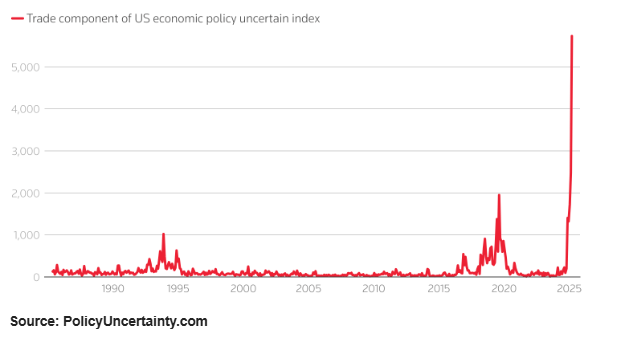
As I drafted this article on Monday, April 7, the Dow was down 500 points, the S&P nearing bear market territory, and U.S. President Donald Trump threatened, yet again, additional tariffs on China. By Wednesday, Trump had paused all tariffs except for China, and the Dow rebounded, hitting its largest one-day point gain…ever. Things are quite fluid, to say the least. The markets hate uncertainty, and according to the index that monitors it, trade uncertainty is at an all-time high.
Let’s take a collective breath, #eventprofs, and remind ourselves that we’ve dealt with uncertainty before. We’ve experienced our industry when things are out of our control. While things are fluid at the moment, now is not the time to worry about what’s out of our control. Now is the time to identify the foreseeable risks to our programs and lead our organizations forward and through them.
Understanding the impact of tariffs
Rather than generalizing on the potential impact that tariffs may have on our programs, let’s break things down in a bit more detail. In the short term, events in certain industries (Government), in certain regions (EU, Asia-Pacific), or around certain topics (DEI) will likely be impacted more than others. Some of your programs will see little to no consequential impact, and in some sectors, meetings and travel will actually increase.
For example, companies that may be impacted by tariffs, directly or indirectly, will likely be traveling to meetings with key suppliers and partners in the supply chain to discuss the impact of tariffs on their products and services. These types of meetings represent activity that would not have happened if it weren't for tariffs.
There are many recent articles and data about goods and services that are more sensitive to tariffs (apparel, consumer electronics, food items, automobiles, alcoholic beverages, steel and aluminum, etc.). Conversely, we should not expect to see meaningful cost increases for items such as AV, local labor, electricity, wi-fi, etc. Crude oil, natural gas, and refined petroleum products are exempt from tariffs from all countries, including Canada and Mexico, and so we should also not expect gas prices to go up to the extent they have a material effect on air fares, shipping costs, etc.
We don’t know how long tariffs will be in play. In my view, tariffs are not intended to be permanent. However, most experts agree that a protracted trade war will almost certainly drive inflation higher. Inflation is currently holding steady, but a meaningful increase would have a broader impact on overall costs much greater than tariffs, themselves. One step at a time.
Budgets holding steady
On Monday at the BTN Strategic Meetings Summit, a room full of industry leaders weighed in on this topic. A combined 76% of attendees said that budgets will remain the same or higher than 2024.
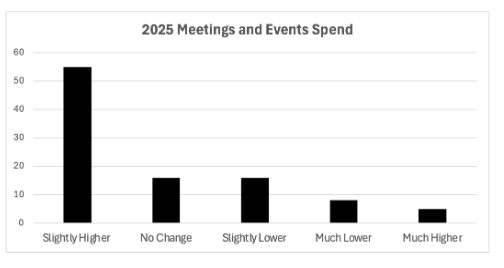
That sentiment echoes recent research from multiple groups suggesting that 2025 budgets in many sectors generally track with the 10+ year historical average.
A proactive approach
Five years ago, I wrote an article suggesting what leaders can do, proactively, in times such as these. The pandemic gave us a playbook to deal with uncertainty, and much of it applies today. Here are few thoughts on what we can all be doing to lean in and lead:
Rally the troops. In times of uncertainty, start with those closest to you - acknowledge the potential impact on your customers, team, and agency partners. It’s a simple first step, and you may have already taken it. If not, address it immediately. Let them know together that you’ll get through whatever comes.
Triage your program using a basic framework. “Level 1 – Urgent” - Understand the commitments to programs and spend that require decisions NOW. Quickly determine the go/no-go decisions that need to be made immediately. Next go to “Level 3 – Not Urgent” – look for projects slated later in the year, program spend that won’t hit until Q4, items from your idea board, etc. De-prioritize these. What’s left should be “Level 2 – Important.” Give this list scrutiny as you may find one or two to elevate to Level 1. That’s all you need to do for now. Now go back to your Level 1s and set a plan in motion. That plan should include being ready to implement some of the virtual event strategies you proved out during the pandemic.
Partner with vendors and suppliers. For your “Level 1” programs, it’s time to connect with key vendors and suppliers. This will be a test of your partnership. Just as it’s time for you to lead, it’s time for our partners to do just that – partner.
Ask for (and expect to receive) cost transparency. Suppliers may already be talking about cost increases stemming from the current economic climate. “Trust but verify” is your modus operandi. In partnership, your key vendors and suppliers should share, with specificity, what is driving cost increases. We know to expect certain increases in produce items coming from Mexico, for example. If the cost of tomatoes is increasing by 25%, that’s what we should see in our supplier’s data.
Consider cost sharing arrangements. Perhaps the ultimate example of partnership, ask key vendors and suppliers to enter a cost sharing arrangement with you. It’s commonplace in certain industries for certain costs, or unexpected cost increases, to be shared between the parties rather than simply passing them along to you, and to attendees. If you work with agencies in this area, collaborate with them on a game plan to take to suppliers together.
These uncertain times are nothing new for the events industry. We’ve faced uncertainty, challenges, and price increases before, and we certainly will again. By taking the time to take a step back, assess the real potential impact and make a plan accordingly, we can ensure that our energy will focus on the priorities within our control, and as leaders, help our organizations navigate the potential pitfalls that can impact our businesses.
Don’t miss any event-related news: Sign up for our weekly e-newsletter HERE, listen to our latest podcast HERE and engage with us on LinkedIn!